October 10, 2026


Your first rows in a shell will sound less like a sport than like a code. The coach says "sit ready — and row," someone behind you mutters that the catch is late, and the rower beside you talks about the run. Nobody stops to define anything, because everyone else already knows.
They learned it the way you will: hear a word, feel it, and slowly connect the two. Here are the terms that come up most in a first season, grouped by where you meet them.
A racing boat is a shell. Its body is the hull. The bow is the front, the part that crosses the finish line first, and the stern is the back. In an eight the coxswain sits at the stern; in a bow-loader, a boat with the cox lying at the front, the orientation is reversed — worth checking before you climb in.
Port and starboard are defined as if you were facing the bow: port is left, starboard is right. Because rowers face the stern, port sits on your right as you sit in the boat. That catches out nearly everyone in the first month.
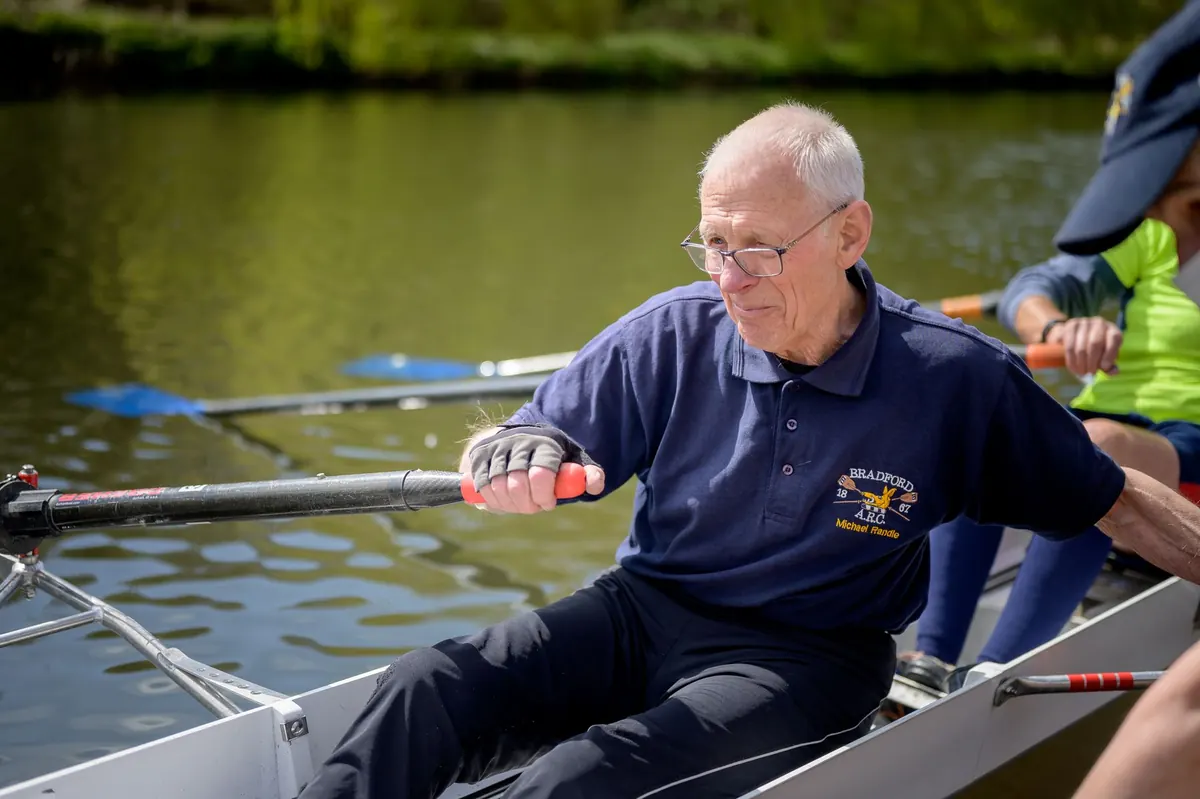
The hardware has names too. Riggers are the metal arms bolted to the hull that hold the oarlocks, also called gates. An oar has a handle, a shaft, a sleeve that sits in the oarlock, and a blade — a wide cleaver on modern oars. Inside the boat, each rower sits on a seat that slides on tracks (or slides), with feet strapped into the foot stretcher.
One cycle of the oar is a stroke, and it splits into four parts. The catch is the instant the squared blade enters the water at the front of the slide. The drive is the push — legs, then body, then arms. The finish, or release, is where the blade comes out and the handle drops away. The recovery is the glide back up the slide, blades feathered, turned flat to the water.
Two words describe blade angle. Square means the blade is vertical and ready to catch; feather means it is flat. Ratio is the balance between time on the drive and time on the recovery — strong crews spend far longer gliding than pulling. That glide is the run, and when a crew moves together you can feel it. When they don't, the boat checks: each stroke brakes the one before it. The rating is how many strokes the crew takes per minute, usually around 20 in a warm-up and well into the 30s for a racing start.
In a sweep boat each rower handles one oar. The stroke sits nearest the stern and sets the rhythm; the bow sits nearest the front. Seats are numbered from bow, so the rower directly ahead of you is one number lower than you are. Coaches often ask the stern pair or the bow pair to lead a drill.
Sweep means one oar per rower, sculling means two, one in each hand. A rower is port-rigged or starboard-rigged depending on which side they pull. The coxswain steers, calls the race plan, and is the only person facing forward.
Commands are short and they repeat all season. Learn these and you will never be the one still rowing when everyone else has stopped.
Boats are named for how many rowers they carry and whether those rowers sweep or scull: single, double, pair, four, quad, eight. On race day you will hear about the regatta, usually a 2,000-meter sprint run in heats and finals, where crews line up at stake boats or buoys. Head races are the autumn version: longer, run as time trials on a river, with boats starting one after another.
Catching a crab is the one everyone fears. The blade gets caught by the water on the recovery, usually because it sat too deep or wasn't fully feathered, and the handle swings into you or the boat lurches to a stop. Washing out means the blade leaves the water early and loses its grip. Skying means the blade rides too high between strokes. Missing water means the catch arrives after the drive has already started. Every rower does all four in their first year, and none of them is a catastrophe.
Ask your coach about one term per practice instead of saving up a list. Repeat commands silently as you hear them, so the word and the movement get wired together on purpose. On the erg, watch rowing footage with the sound on and name what you see as it happens. And when a crewmate uses a word you don't know, say so — every rower in the boathouse asked that same question once, usually while sitting at the wrong end of a bow-loader.

All about rowing as a hobby.
Copyright © 2026 Row Hobby. All rights reserved. Row Hobby.